For circus winches and lifting systems, we use an eightfold safety factor for steel wire rope when the system lifts a person or supports occupied circus apparatus. This figure comes from the appendix to Russian occupational-safety rules approved by Ministry of Labour Order No. 914n.
The rules recommend a factor of 8 for steel wire ropes used to raise or lower people and to suspend circus apparatus carrying people. The same appendix gives other values for other applications: 6 for lifting loads or reeving tackle systems, and 4 for suspending unoccupied apparatus or forming guy ropes. The function of the system sets the starting requirement.
What the factor of 8 means
The simplified relationship is:
Fmin ≥ 8 × Smax
Fmin is the minimum breaking force of the complete rope stated in the manufacturer's certificate. Smax is the maximum calculated tension in the working rope leg. If the maximum tension is 2 kN, the rope needs a confirmed breaking force of at least 16 kN. Engineers calculate with force in newtons rather than comparing catalogue values expressed as kilograms.
The formula does not permit an operator to lift eight times the rated load. The rated capacity remains the operating limit. The factor separates the working load from the tested breaking strength of a new rope.
Why rope tension exceeds static weight
The mass of a performer or apparatus provides only the starting value. The rope also carries acceleration during starting, braking, changes of direction and potential shock. A controlled drive reduces dynamic force but cannot remove it.
Reeving changes forces in rope legs and loads on blocks. Friction in grooves and bearings prevents ideal distribution. A tilted block, incorrect fleet angle at the drum or non-parallel lines add local stress. The designer calculates the real reeving arrangement instead of dividing the load by the number of visible rope parts.
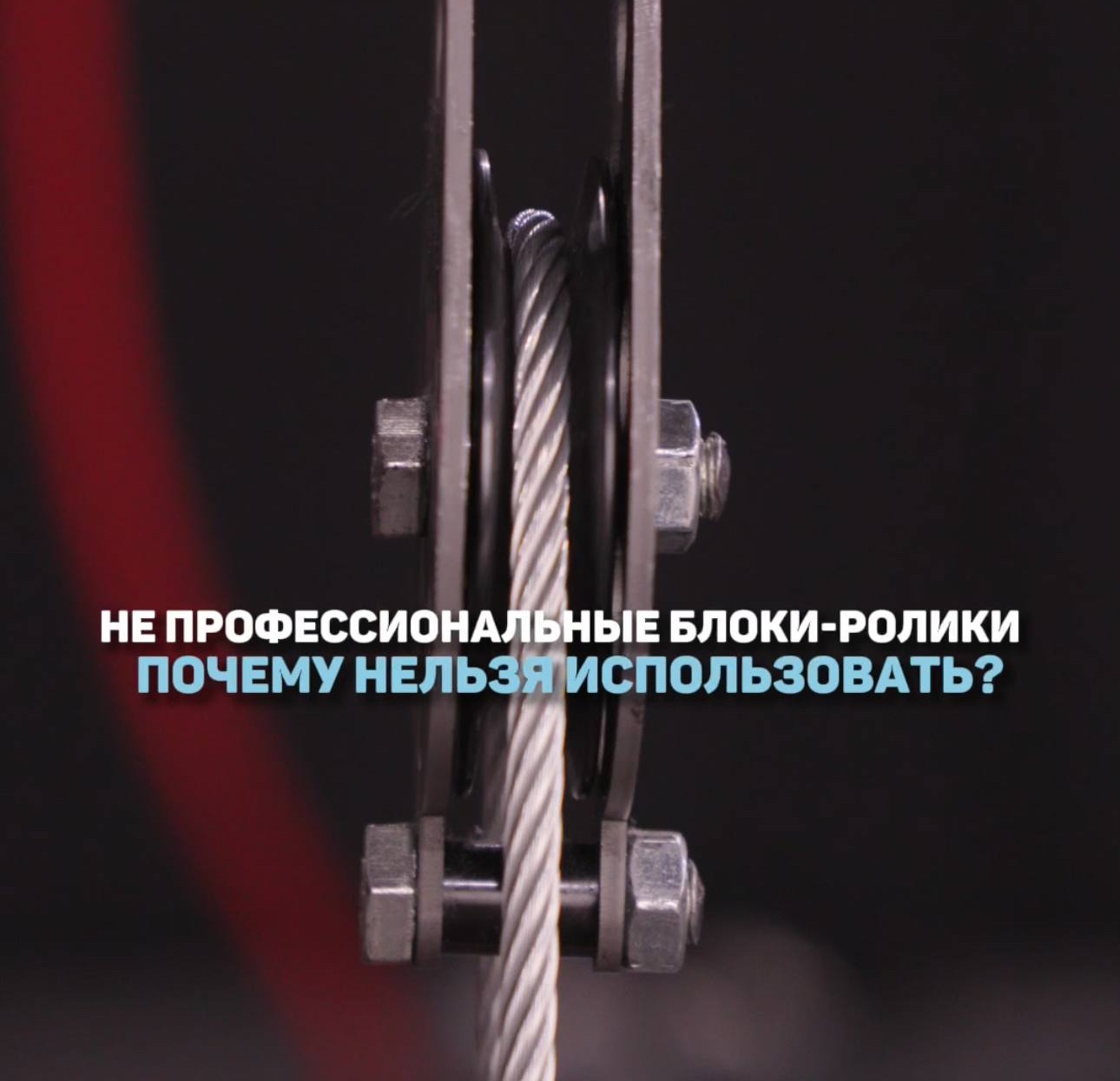
Rope running over drums and sheaves undergoes repeated bending. Wires stretch, compress and contact other wires and the groove. Small sheaves, an unsuitable groove or poor lubrication accelerate fatigue. These conditions do not change the rated load, but they reduce rope life.
What the engineering reserve covers
The eightfold ratio creates separation between calculated tension and the breaking force of a new rope. It accounts for property variation, dynamic effects and the gradual loss of condition in service. The reserve supports the design of a real mechanism in which rope moves, bends and ages.
Several effects consume rope capacity and service life:
- Dynamic force. Starting, stopping and shock raise tension for short periods.
- Bending fatigue. Every cycle over a drum or sheave uses part of the wire fatigue life.
- Terminations. A socket, thimble, wedge or other termination needs confirmed efficiency and correct installation.
- Wear and corrosion. Loss of metallic area reduces residual strength.
- Reeving effects. Friction, fleet angle and unequal line distribution change actual forces.
The factor does not replace calculation of these effects. It applies after the engineer has established Smax for the specified operating regime. Using static weight in place of maximum tension can produce a misleading factor of 8.
Standards do not assign one number to every mechanism
GOST 33710-2015 sets minimum rope-utilisation factors according to application, mechanism duty, rope type and drum type. Rostechnadzor Federal Rules No. 461 use a related approach at hazardous production facilities: the rope must match the equipment passport, carry a manufacturer certificate and satisfy the ratio between breaking force and maximum rope-leg tension.
For circus work involving people, Order No. 914n provides the factor of 8. We use it as the lower limit for the corresponding system. A higher value governs when the project specification, another mandatory rule or the risk assessment requires more reserve.
Federal Rules No. 461 apply to hazardous production facilities and the lifting structures covered by their scope. A stage winch does not become hazardous-production-facility equipment by default. The operator must determine applicability for the specific venue. Manufacturer requirements and Order No. 914n continue to apply within their respective scope.
The rope factor does not rate the complete system
A rope factor says nothing about the strength of the drum, sheave pins, frame, fasteners or suspension point. The brake, gearbox, drive, limit switches and control system need their own calculations and checks. The designer identifies the weakest element across the full load path.
Moving a person requires more than rope strength. The system needs controlled motion, protection against unintended descent, emergency stopping and a defined response to failure. Risk assessment and the performance scenario may require a separate safety line or redundancy.
An eightfold reserve does not justify overload, shock movements outside the design case or operation from an unverified suspension point. It cannot make an uncertified rope acceptable.
Maintaining the reserve in service
GOST 33718-2015 gives general principles for the care, maintenance, inspection and discard of wire ropes on cranes. Order No. 914n requires replacement of worn ropes with damaged strands, a failed core, corrosion or broken wires. The system manufacturer sets inspection intervals and any additional criteria.
Inspection covers the working length, termination areas, multilayer winding zones and sections passing over sheaves. The inspector records diameter change, broken wires, corrosion, deformation, heat damage and lubrication condition. Overload, jamming or shock requires inspection before further use.
A new rope selected at a factor of 8 can lose its fitness for service through damage. An old rope cannot rely on its original certificate as proof of current condition. The discard decision follows its measured condition and the applicable criteria.
References
- Appendix to Russian Ministry of Labour Order No. 914n with recommended safety factors.
- Official publication of Russian Ministry of Labour Order No. 914n.
- GOST 33710-2015, Cranes: Selection of wire ropes, drums and sheaves.
- GOST 33718-2015, Cranes: Wire-rope care, maintenance, inspection and discard.
- GOST EN 12385-1-2015, Steel wire ropes: Safety, Part 1, General requirements.
- Rostechnadzor Federal Rules No. 461, operation and replacement of steel wire ropes.
Conclusion
The factor of 8 relates certified rope breaking force to the maximum calculated line tension in systems lifting people or suspending occupied circus apparatus. It follows the sector rule, provides reserve for real rope service and still requires regular inspection. A number alone cannot create safety without load calculations, suitable sheaves, a sound mechanism and documented checks.